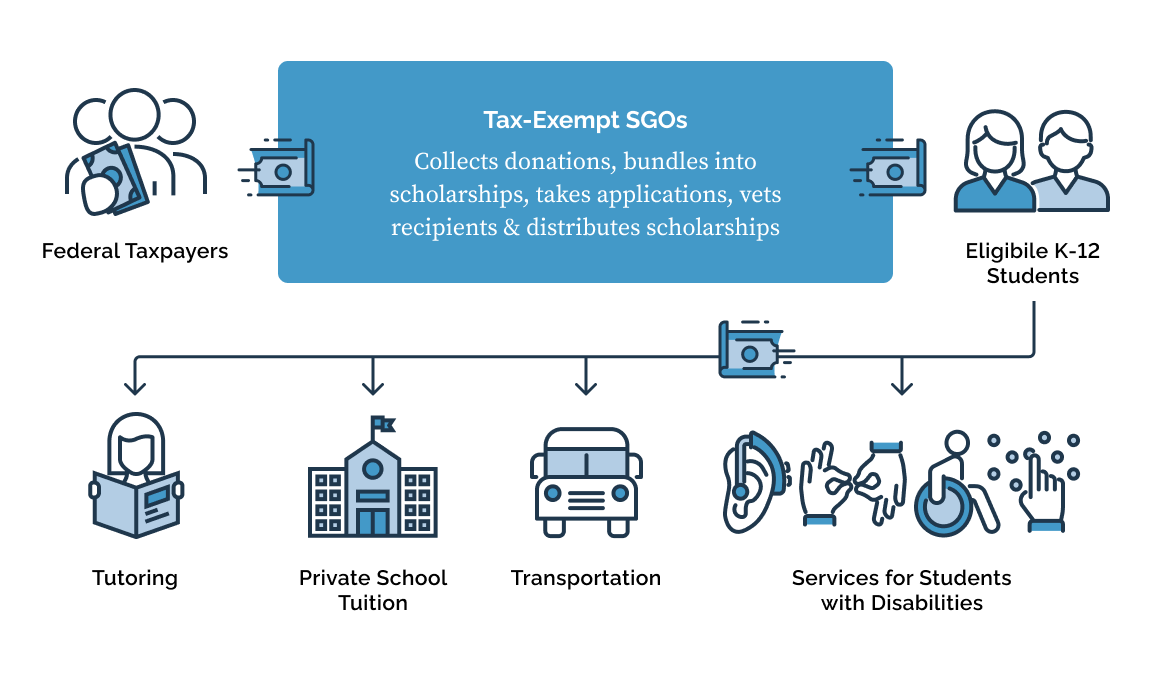
Starting in 2027, K-12 students will be able to access a variety of scholarships, thanks to the Federal Scholarship Tax Credit. Students in public and charter schools might seek scholarships for tutoring. Students in private or religious schools might seek tuition scholarships. And home school families might seek scholarships for special academic programs or curriculum.
The FSTC provides a dollar-for-dollar credit up to $1,700 annually. Contributions above the cap or the tax liability can be carried over or eligible for tax deductions. (See “For Taxpayers and Donors” for more information.)
The SGO raises funds, designs scholarships (including which students and educational providers), takes applications from students, confirms student eligibility, provides donor documentation, interacts with the IRS and other government agencies, and awards K-12 scholarships. (See “For Scholarship Granting Organizations” for more information.)
Within limits set by the SGO and federal law, families direct how their scholarship funds are used. (See the “For Families and Students” for more information.)
In some states, the three-step process might be derailed. The law requires governors to opt in—meaning that, until they opt in, SGOs cannot distribute—and students cannot receive—FSTC-funded scholarships in the state. Once a governor opts in, the state will compile a list of the SGOs that comply with the law and operate in the state. This list of SGOs is where families can go to seek scholarships.
The FSTC Coalition anticipates hundreds of SGOs springing up to serve different student populations with various educational approaches and programs.
Because this will empower families to choose among more K-12 options, many call this law an Education Freedom Tax Credit. A core concept driving the FSTC is that, to improve outcomes for our students, families need and deserve more educational choices that fit each child’s needs.